Your store looks like every other Shopify store. Here is what a boutique in Hilo did about it.
Two stores, a café, prints they draw themselves, 17.5K followers, and a website that hid all of it. What Wehi's Boutique built instead, and what any boutique can copy this week.
- Build
- Custom Shopify storefront
- Read
- 10 min
- Market
- Hawaiʻi + Tokyo
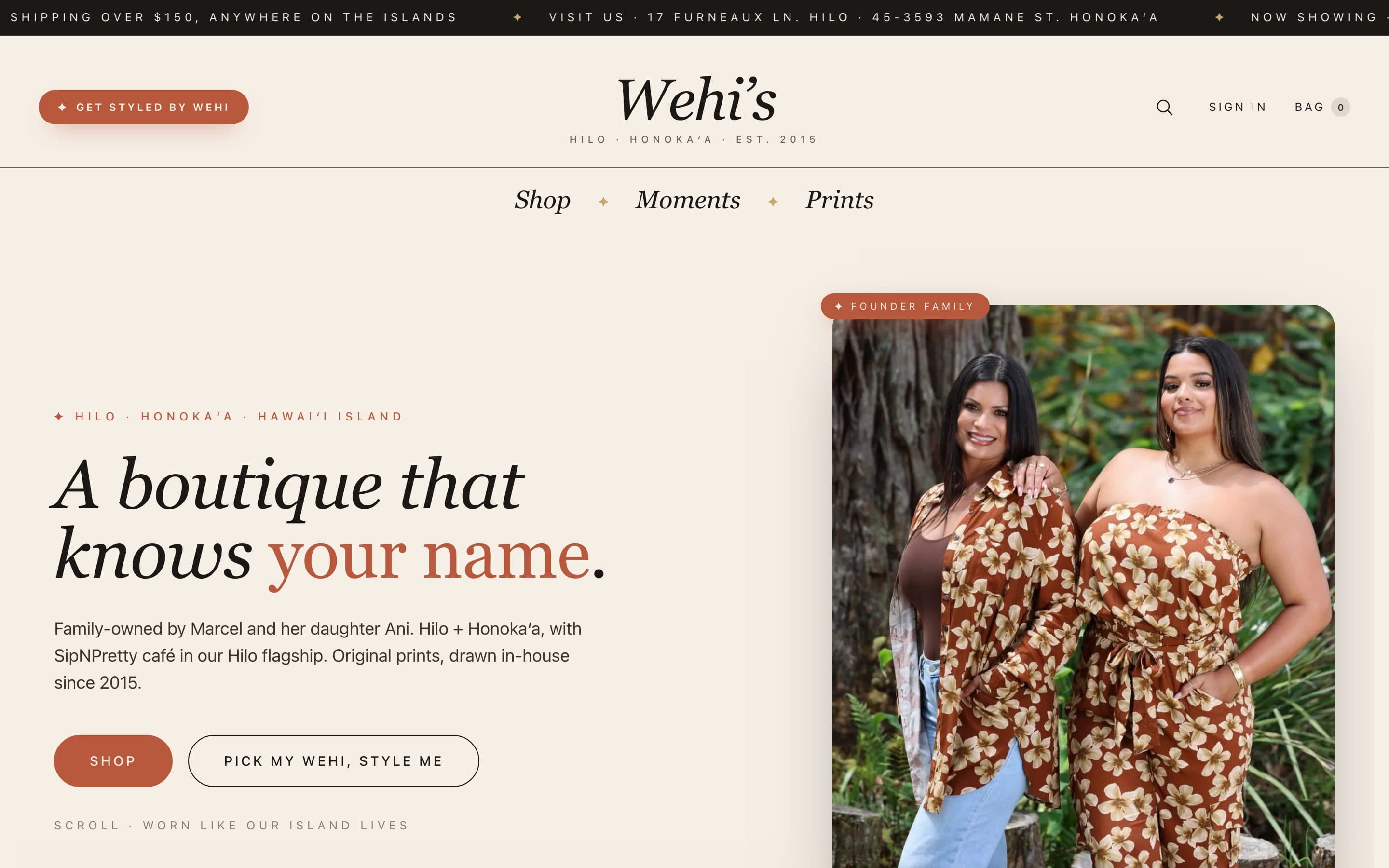
Marcel Rodrigues and her daughter Ani run Wehi's Boutique. Two stores on Hawaiʻi Island. The original on Mamane Street in Honokaʻa, open since 2015. A flagship on Furneaux Lane in Hilo with a SipNPretty café inside it, the only boutique on the island with a café inside. They draw their own aloha-wear prints. They have 17,500 people following them on Instagram. Locals wear Wehi to church, to the farmers market, to a lūʻau on Sunday.
That is more raw material than nearly any boutique on this island. And the website hid every bit of it.
Here is what a stranger saw. A gray banner. Three menu items: Home, Shop, Our Story. A hero line that could sit on any of 200 boutiques. No mention of the Hilo store. No mention of the café. No mention of Marcel or Ani. No print names, no print stories. No structured data, so an AI search engine had nothing to read. When we asked ChatGPT for the top boutiques on Hawaiʻi Island, Sig Zane was on the list. Hilo Hattie was on the list. Smaller shops were on the list. Wehi was not.
If your store looks like that, you are not behind. Most are. A default theme is built to work for everyone, which means it says nothing about you. Here is what Wehi did about it, and what you can take from it without hiring anyone.
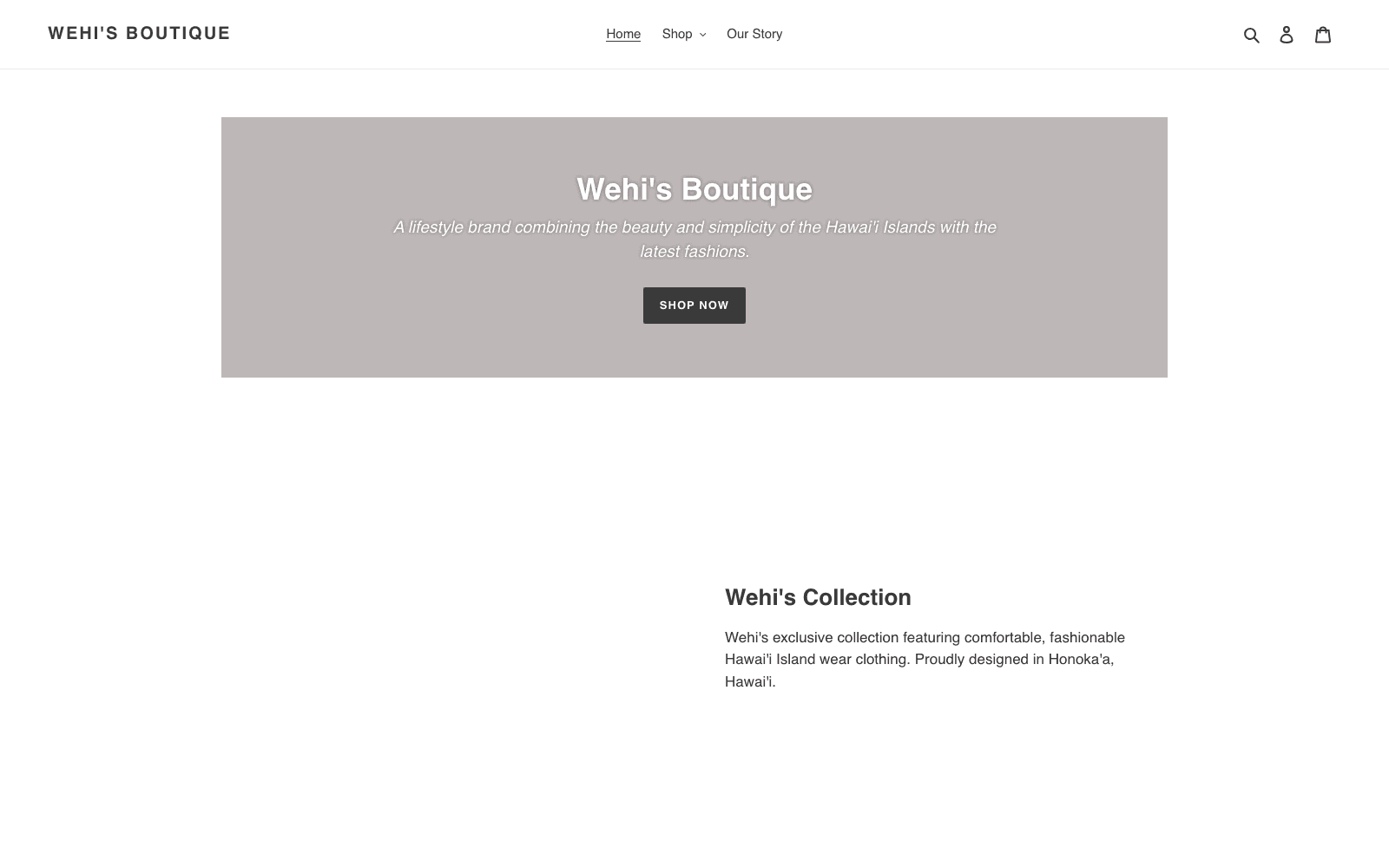
A lifestyle brand combining the beauty and simplicity of the Hawaiʻi Islands with the latest fashions.
Read that line again. Now cover the logo. Could it be any boutique in Hawaiʻi? Could it be a hotel gift shop? That is the test your home page has to pass, and most fail it.
Tell the story a template hides
A template gives you a banner, a grid, and a footer. It does not give you a place to say you have two stores. It does not give you a place to say there is a café inside one of them. It does not give a print a name, a meaning, or a reason it exists. So those things disappear, and your store reads like a catalog with your logo on top.
Wehi's lane is simple to say. The modern Hawaiian lifestyle brand for everyday island women. Not luxury. Not tourist. A store for the life you actually live here. Once that was written down, the whole site had a job: prove it.
So the new store names both locations. It carries the founders. And every house print gets a record we call a wehi_print, with its cultural meaning written in English and partial Japanese, so the story behind a pattern travels with the product instead of living in Marcel's head. A shopper in Tokyo can read why a print exists. So can an AI engine.
Here is the script for the hero line. Fill in the blanks and cut anything that is true of your competitors too. "We are a [what you are] in [your town]. We [the one thing only you do]." If you cannot fill the last blank, that is the real problem, and no website fixes it.
Let the site do what your best salesperson does
Walk into the Hilo store and the best person on the floor does not hand you a catalog. She asks. Where are you going. How do you want to feel. What size. What is your budget. Then she pulls three hangers and tells you why each one works. That is the whole job, and it is why the store sells.
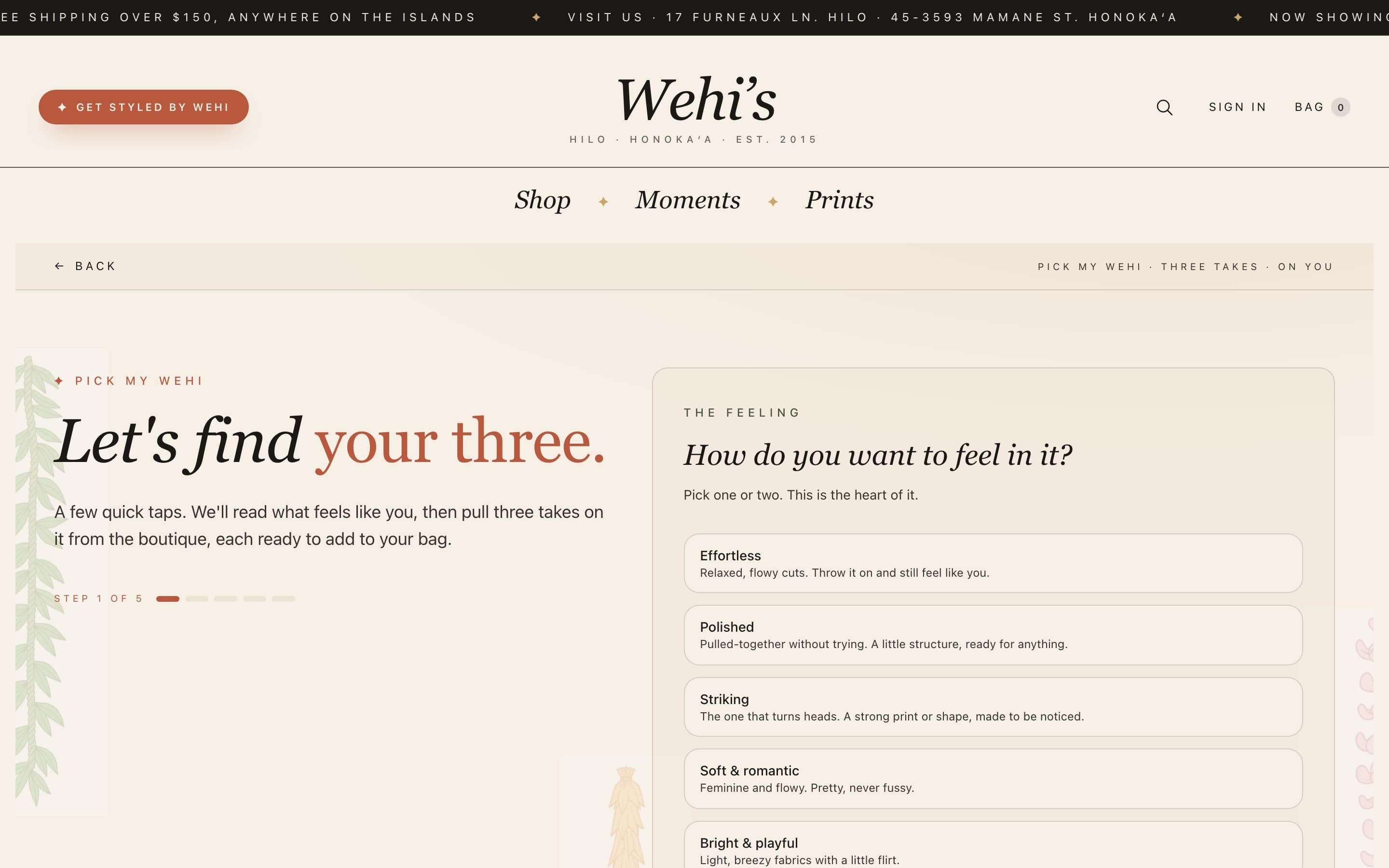
The website did none of that. It showed a grid and let the shopper guess. So we built the salesperson into the site. It is called Pick My Wehi. A shopper answers five short questions: how she wants to feel, her color mood, her shape and size, the moment, and her budget with any hard-nos. The store maps her moment to a live collection, pulls about 30 real products from current inventory with prices and photos, filters out anything over budget or against her rules, and scores the rest. Then it hands back three complete outfits, one easy, one dressier, one statement, each with a written reason. Every pick is a real product in stock right now. Every look is one tap to the bag.
Say she is headed to a lūʻau. She taps effortless, warm tones, her size, the occasion, her budget. Pick My Wehi reads that, pulls the aloha pieces that actually fit, and hands back three looks she can wear on Sunday. No scrolling twelve pages of dresses hoping to guess. That is what a good salesperson does. Now the site does it at 11 pm.
One more thing, because it matters for anyone who has watched a demo break in front of a customer. If the AI call fails, there is a fallback that picks three looks the old-fashioned way, so the stylist never goes blank on a shopper. That is the difference between a demo and something a store can run every day.
Live candidates per session
Pulled from real inventory before a single look is picked, so every outfit it hands back is something the store can sell today.
Sell what actually sells
Most boutique home pages show what the owner likes. The register shows what customers buy. Those are not the same list, and the gap costs you sales every day.
Wehi's catalog is a good example of how that gap grows. When we audited it there were 984 products in 10 collections with no real structure. Marcel had already done the hard curating and published 212 of them online. The problem was not the products. The problem was that nothing on the site told a shopper which ones people loved.
So the new store has a Most Loved row driven by real Shopify best-seller data, not a guess. It updates itself. There is a drops system for new releases with a countdown, a notify-me capture, and a drop-lock so nobody can buy a piece before it goes live. Free shipping kicks in over $150 on-island, and the site says so. And email capture runs through Klaviyo, because 17,500 Instagram followers is a rented audience and an email list is one you own.
Here is the part you can do today. Open Shopify. Analytics. Sales by product, last 90 days. Take the top five and put them on your home page above the fold, with the word "best sellers" next to them. That is a Most Loved row. It is not automatic, so put it on your calendar to redo every month. If you release new pieces, stop dripping them out. Name the release, pick a date, and tell your list a week ahead. A drop with a date sells more than a restock nobody heard about.
And the email list. If you have 5,000 followers and 200 emails, the job this month is not more followers. It is a sign at the register and a box on the site that says what they get for signing up. Wehi's plan calls for a first-order discount and a letter from Marcel. Yours can be a first look at the next drop. Say it in plain words and ask.
Build for the customer who flies home
Every shop on this island has the same customer nobody builds for. She walks in on Tuesday, loves the place, buys one thing, and flies home Thursday. Then she is gone, and your store has no way to sell to her again.
For Wehi, a lot of those customers fly home to Japan. The reasoning is worth knowing even if your visitors come from somewhere else. Japan has about two million people who study or dance hula, and they buy real aloha wear for performances, classes, and everyday life. Japanese visitors to Hawaiʻi come back again and again once they love a brand. And most of them never leave Oʻahu, which means a Big Island shop has to be known in Japan before the trip, not discovered by luck during it.
So the store has a Japanese path at /ja. The print meanings are written in English and partial Japanese so the story survives the translation. Shopify handles the currency and the checkout for the market. Nothing exotic. Just a store that works the day she lands back in Tokyo and remembers the dress she did not buy.
Be findable when someone asks an AI where to shop
People do not only search Google anymore. They ask ChatGPT where to shop in Hilo. They ask Perplexity what to wear to a lūʻau. Those engines do not rank pages the old way. They read what they can find, trust what is clear, and name the shops they can describe.
That is why Wehi was invisible. Sig Zane has thirty years of press and a long story online. Wehi had a hero image and three menu links. An AI engine could not describe Wehi, so it did not name Wehi. It was not a ranking problem. It was a nothing-to-read problem.
The fix is facts in plain words, in places a machine can read them. Product pages on the new store carry product schema. The print records give an AI a story no other store on earth can tell, because nobody else drew that print. Both locations, the café, and the founders live on the site now, which is what an engine needs to connect "Wehi" to "Hilo" to "boutique" to "café inside."
Here is how you check your own store in two minutes. Open ChatGPT. Type "best boutiques in [your town]" and "where should I shop for clothing in [your town] that is not touristy." If you are not on the list, do not panic and do not buy anything. Do this instead:
- Write one about page that names everything on one page: your store name, your owners by name, your street, your town, your island or region, and the one thing only you do. Engines connect entities. Give them the entities.
- Add a FAQ to your home page that answers the exact questions people ask an AI. "Where is [store] located?" "Who owns [store]?" "Does [store] ship to the mainland?" "Are the prints original?" Answer first, then context, in plain words.
- Fill out Google Business Profile for every location. Hours, photos, a reply to every review. AI engines pull from it heavily.
- Write the stories only you can write. What your print means. What a Saturday looks like in your town. What to wear to a lūʻau. One a month is enough. Each one is a page an engine can cite.
- Ask a local paper to cover your next release or anniversary. One article about you, on a site an engine already trusts, does more than a hundred product pages.
Check again in 90 days. Same two questions. This is the one metric for this work that you can measure for free.
Do this for your store
Five questions. They work for a boutique, a gift shop, a surf shop, or a bakery. Answer them honestly and you will know what to fix first, and most of it will not cost you a dollar.
- If a stranger read your home page with the logo covered, could she tell it was you? If not, put the three facts a template hides in the first screen: where you are, who runs it, the one thing only you do.
- What does your best salesperson ask before she pulls a hanger? Write those questions down and put the simplest version on your site, even a "Help me pick" form you answer by hand.
- What sold the most in the last 90 days, and is it on your home page? Pull the report, put the top five above the fold, and redo it monthly.
- Where do your customers fly home to? Ask at the register for two weeks, and build for the answer that shows up most, starting with a line that says you ship there.
- When you ask ChatGPT for the best shops in your town, are you on the list? If not, write the about page and the FAQ above, fill out Google Business Profile, and check again in 90 days.
If you do all five and the store still cannot do what you need, that is the day a custom build makes sense. Not before.
What we did not build
Honest scope. There is no visual try-on and no AR. Pick My Wehi is a stylist, not a mirror. Checkout stays on native Shopify. We did not hand-roll payments, and you should not want anyone to. Money stays on the platform built to handle it.
There is also a separate, password-protected content studio that helps Ani write on-brand captions and trend briefs. It sits next to the store, not inside it, so the shopping experience stays clean.
And the part most case studies skip. We have not measured Wehi's results yet. No sales lift, no traffic number, no "now on the ChatGPT list." The plan names what to measure: email list size, sessions, online revenue, average order, reviews, and whether Wehi shows up when an AI is asked about Big Island boutiques. When those numbers are honest to report, they go here. Until then, what you have on this page is the thinking, and the thinking is the part you can copy.
If you have done the five questions and your store still needs more than a theme can give, this is the kind of work we do. Start with the $950 Audit + Direction and we will tell you plainly whether you need a custom build or a Saturday with a notepad. Or see more of the storefronts and systems on the work page.
For the technically curious
What is under the hood, for anyone who wants to know.
- Framework
- Shopify Hydrogen, React Router 7, React 19, TypeScript, Vite
- Hosting
- Shopify Oxygen, a Workers runtime
- Data
- Storefront, Admin, and Customer Account APIs
- Checkout
- Native Shopify checkout, not hand-rolled
- Stylist
- Pick My Wehi, about 1,000 lines plus Claude, deterministic fallback
- Merchandising
- Timed drops with drop-lock, live best-sellers, typeahead search
- Content
- wehi_print metaobjects, product schema, bilingual /ja for Tokyo
- Scale
- About 19,500 lines, 107 files, 35 routes
Talk to us about a boutique or e-commerce brand build.
Free AI audit first. We read your site, your reviews, your visible stack, then return a prioritized roadmap with a savings estimate. No deck, no upsell. Sometimes we tell you not to build anything yet.
Ready to build? Start with a Website Audit and Direction for $950. Build with us within 30 days and the $950 credits back.
Ascend Creative, run by Binil Chacko. 300+ websites in 13 years.
See where a boutique or e-commerce brand like yours is leaking money before you talk to anyone. Free, no signup.
Related reading
- 01
Your best marketing is the thing you already do well. Give it away.
Hilo, HI
A Hilo guitar shop, a free first lesson, and five questions any local shop can answer.
- 02
The salon that stopped losing after-hours bookings.
Honolulu, HI
A local service business, a website that books while they sleep.
- 03
The business-plan builder that ships plans in minutes.
Product build
A custom application, not a template. What serious custom software looks like.