PlanMason: the custom AI platform we built from scratch.
Most people know Ascend for websites. PlanMason is the proof we build real software too. A founder types in a rough idea, and the platform coaches it into a lender-ready business plan with real financial projections.
- Build
- Custom platform
- Read
- 9 min
- Stack
- Next.js / Supabase / Claude
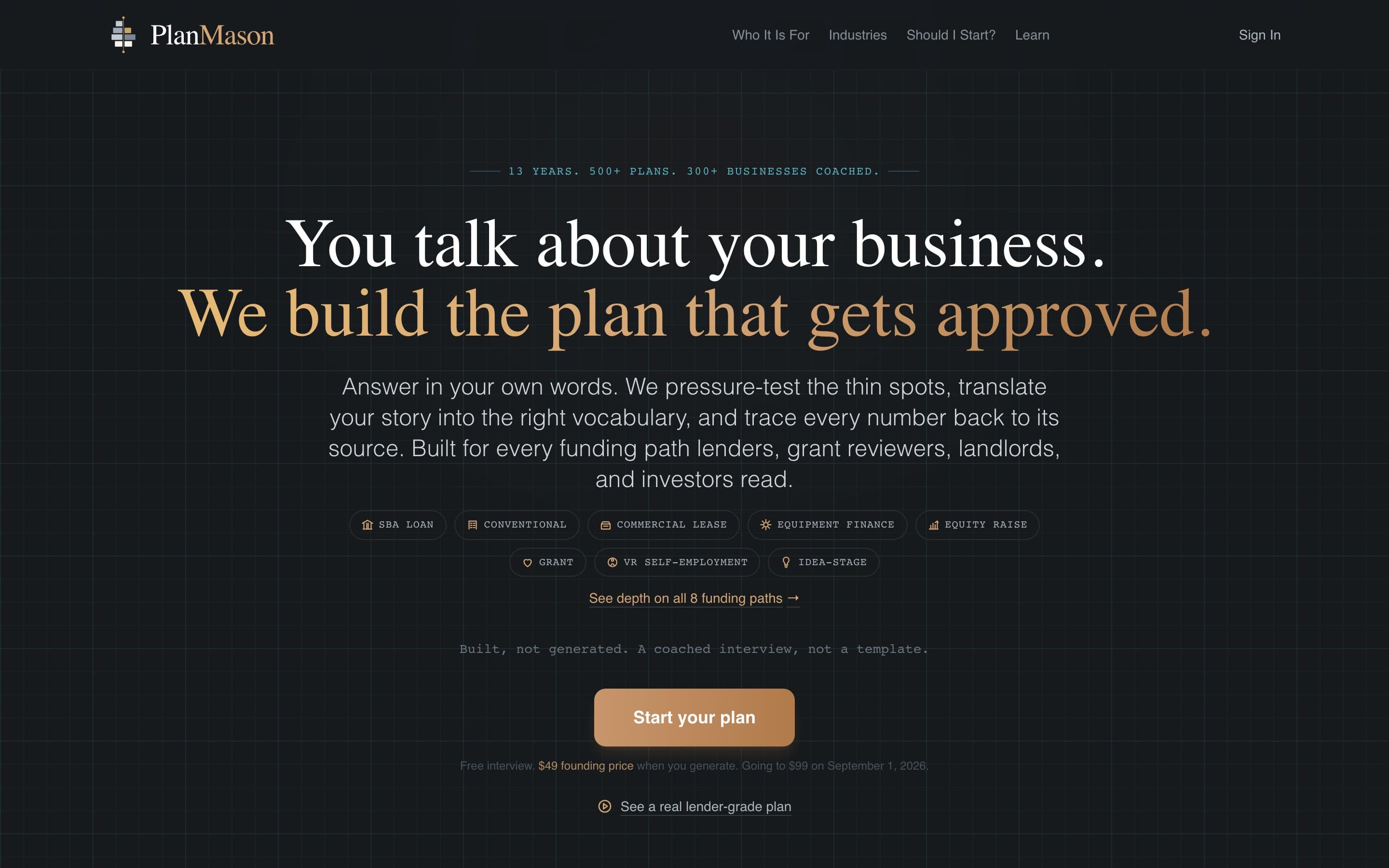
PlanMason is a platform we built from nothing. A founder shows up with a rough idea. The platform interviews them, coaches the weak answers, computes the numbers, and hands back a lender-ready business plan with real financial projections. It runs at planmason.com. It takes payment. It has real users. It is not a website with a chatbot bolted on. It is a custom AI SaaS, and Ascend Creative built the whole thing.
We are writing this one up because it answers a question we get from serious buyers: can you build actual software, or just marketing sites? The honest answer is both. This is the case study for the software. If you are shopping for custom AI platform development, or a custom AI application, or full-stack application development, this is the work.
What custom AI platform development actually means
The stack is Next.js 14 with the App Router, TypeScript in strict mode. Roughly 418 source files. About 171,000 lines of application code. It is hosted on Vercel, configured to allow long-running plan generations up to the platform ceiling. This is a real full-stack backend, not a template with the serial numbers filed off.
The data layer. Postgres through Supabase. Fourteen tables, every one governed by row-level-security policies. Thirteen migrations tracking how the schema evolved. Authentication runs through Supabase with route-level middleware guarding the private areas of the app and eighteen API routes. A user can only ever touch their own data. That is not a setting you toggle on. It is built.
Billing you can trust. Stripe handles checkout and the per-plan charge. The webhook verifies its signature, and a dedicated events table gives us idempotency, so a payment is recorded exactly once and never double-counted. Email runs on Resend with sixteen React Email templates. Rate limiting uses Upstash Redis. Analytics runs on PostHog and Vercel. When people ask whether we build the full backend, auth, and billing, this is what we point at.
Application code, from scratch
A full-stack custom AI platform, not a template. A 14-table secured backend, Stripe billing, and an anti-hallucination engine underneath it.
The hard part: an AI that cannot lie about money
Here is the problem with putting a language model in front of financial projections. Language models make up numbers. They will confidently write a revenue figure in one section and a different one three pages later. For a document a founder takes to a lender, that is not a rough edge. It is a dealbreaker.
So we built PlanMason so the AI is never allowed to write a raw dollar figure. Not once. Instead it emits placeholder citation tokens. A resolver then binds every token to one source-of-truth financial-facts map before the plan is rendered. The numbers themselves are computed in code by a deterministic financial engine, roughly 5,600 lines, with a tie-out layer that forces the statements to actually balance. The model gets to write the prose. It does not get to touch the math.
The AI writes the words. The code owns the numbers. They can never argue with each other.
This is the difference between a custom AI application and a plugin. Off-the-shelf tools do not do this, because doing it requires designing the constraint into the platform from the data model up. It is the single most important engineering decision in the product, and it is the reason the output is safe to hand to a bank.
The AI layer, built to fail gracefully
The AI runs on Anthropic Claude, with Sonnet as the primary model and lighter Haiku tiers for smaller tasks, across thirteen AI-powered routes. The core of it is a per-section orchestrator, around 1,500 lines. It fans out one Claude call per plan section and runs them in parallel batches under a single global time budget. It carries a retry budget that feeds validation errors back to the model as feedback, and it falls back gracefully instead of failing the whole plan. This replaced an earlier single-prompt approach that could not hold quality across a long document.
Feeding that engine is a nine-phase guided interview, roughly 5,000 lines and about 250 questions across identity, business model, customer and market, competition, marketing and sales, operations, team, financials, and funding. It does not just collect answers. It assesses each one and asks a sharper follow-up when an answer is thin. That is how a rough idea becomes something a lender will read.
What the platform actually produces
When the plan is done, PlanMason exports it. There is a Word document builder, around 8,800 lines, for the full written plan. There is a 30-worksheet Excel financial workbook. There is a lender packet and a one-page pitch. Behind that sits a validation and QA suite: a cross-section validator, a cohesion pass, a market-sizing validator, and red-flag detectors, plus seventeen test files including golden-fixture regression tests so a change to one part cannot quietly break another.
It ships with twelve lender-underwriting profiles, covering SBA, conventional commercial, commercial real estate, equipment finance, equity raises, and more, so the plan is shaped for the money the founder is actually trying to raise. There is an admin console and an advisor and partner portal on top of all of it.
What this proves about full-stack application development
The build reportedly took about 1,200 hours. That is the builder’s figure, and we will state it as that. The proof we want you to weigh is not the hours. It is the code. 171,000 lines. A 14-table backend secured with row-level security. Signature-verified billing with idempotency. And an anti-hallucination engine that off-the-shelf tools do not have. That is verifiable, and it is the point.
If you have an idea that needs real software, this is the range we work in. A custom AI platform, a custom AI SaaS, a custom community for your business, a tool that has to hold up under real users and real money. You can scope a custom build with us directly, or see more of what we've shipped in the work. Websites are where most people meet us. PlanMason is what happens when the job is bigger than a website.
The build at a glance
A full custom platform, owned end to end.
- Framework
- Next.js 14 App Router, TypeScript strict
- Scale
- About 171,000 lines, 418 files, 44 API routes
- Data
- 14 Postgres tables, all row-level secured
- Billing
- Stripe, signature-verified webhook, idempotent
- AI
- Claude, 13 routes, per-section orchestrator
- Safeguard
- Citation-token engine, no AI-invented numbers
- Interview
- 9 phases, about 250 coached questions
- Output
- Word plan, 30-sheet Excel, lender packet
Talk to us about a custom platform or AI product build.
Free AI audit first. We read your site, your reviews, your visible stack, then return a prioritized roadmap with a savings estimate. No deck, no upsell. Sometimes we tell you not to build anything yet.
Ready to build? Start with a Website Audit and Direction for $950. Build with us within 30 days and the $950 credits back.
Ascend Creative, run by Binil Chacko. 300+ websites in 13 years.
See where a custom platform or AI product like yours is leaking money before you talk to anyone. Free, no signup.
Related reading
- 01
The boutique that needed a real platform, not a page.
Case study
When the job outgrows a website and turns into software.
- 02
The HVAC quote bot that had to get the number right.
Austin, TX
AI reliability when a wrong figure costs a real job.
- 03
The law firm chatbot that could not guess.
Boca Raton, FL
Guardrails so an AI answers only what it actually knows.