Your best marketing is the thing you already do well. Give it away.
If your site is a stale page and Yelp wins your own name, you do not need a prettier page. You need a reason for people to walk in. Here is how a Hilo guitar shop turned its first lesson into a front door.
- For
- Local shops and services
- Read
- 8 min
- Example
- Big Island Guitars
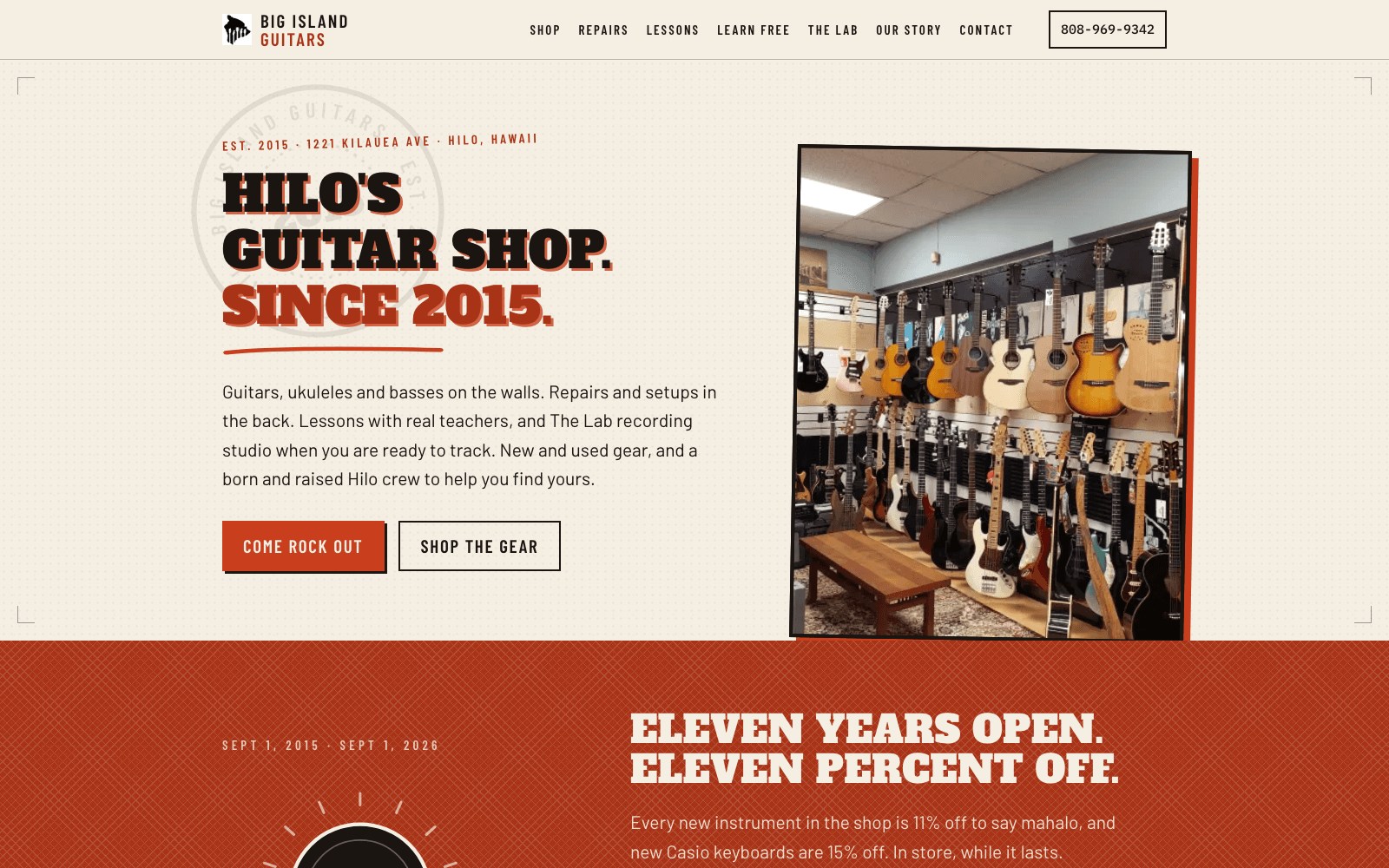
Your website is a page somebody set up years ago. The hours on it are wrong. When people search for what you sell, Yelp and a few directory sites show up above you, and one of them has a review you would rather nobody read. The real business runs on Facebook, a phone number, and the people who already know you. You keep meaning to fix the site. You have been meaning to since 2020.
Here is the thing most shop owners get wrong at this point. They think the fix is a better-looking page. It is not. A prettier page does not give anyone a reason to walk in. The fix is to take the thing you already do well, every day, at the counter, and give it away online. Then point every path back to the door.
What one shop in Hilo did about it
Big Island Guitars and Music Supply is at 1221 Kilauea Ave in Hilo. Spencer and Laura Ahuna opened it in 2015 with the money they won on Wheel of Fortune. Repairs are Spencer's specialty. Teachers run lessons there seven days a week. There is a recording studio in the back and a free ukulele jam every first Saturday. About 4.9 stars across 50 plus Google reviews. The sign says come in, rock out.
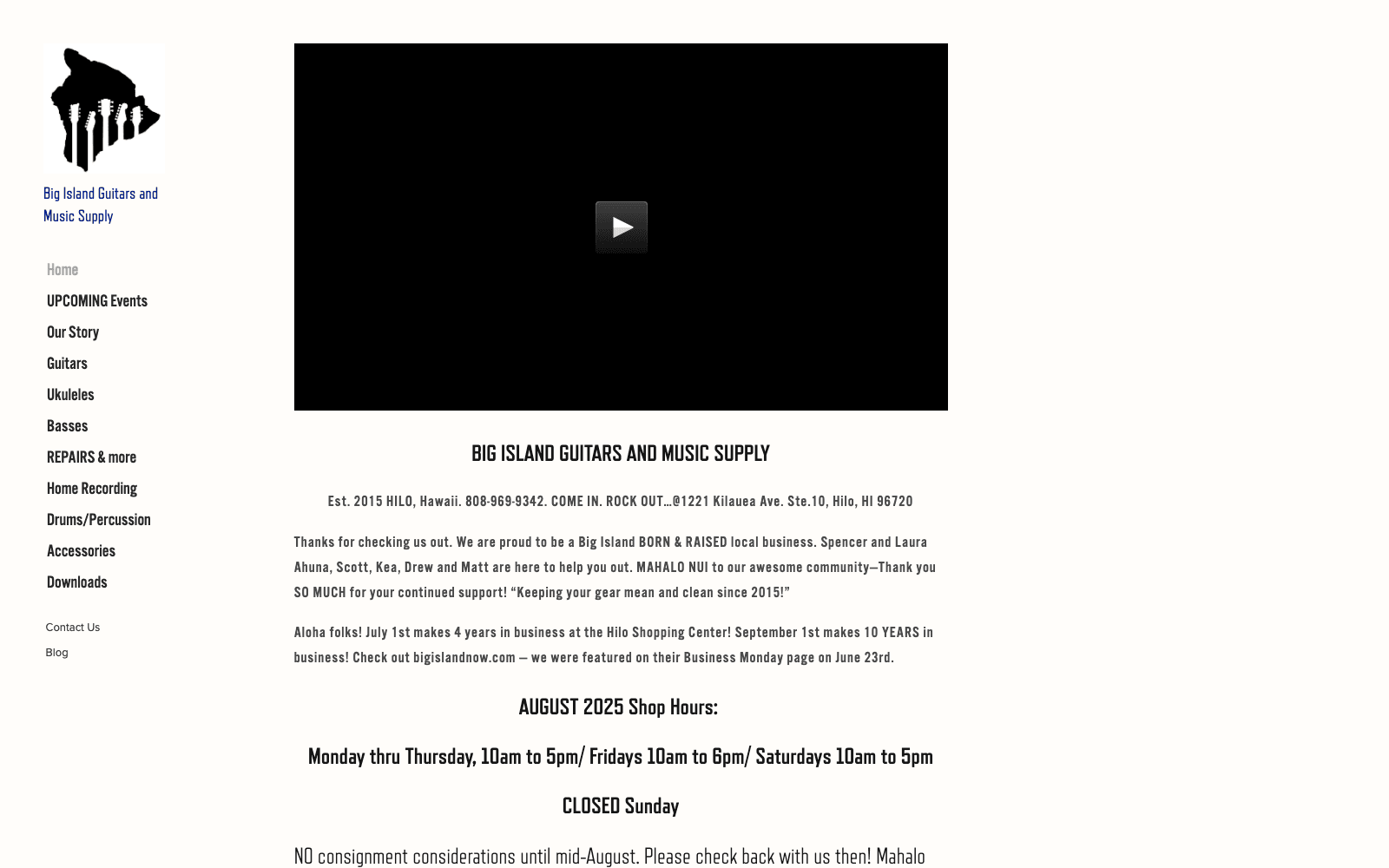
Their Squarespace site did not know any of that. The contact page showed September 2020 pandemic hours that contradicted the home page. The navigation had a default slug, /new-page-1. Product pages had no products. No booking, no schema, an empty blog. The about page opened with Laura saying there had been no time to update it. So Yelp and directory pages outranked the shop for nearly every search that did not include its name. Ten years of earned trust, leaking to aggregators.
If that sounds like your site, keep reading. The rest of this is the decisions, in the order we made them, written so you can make the same ones for your own shop.
Give away the thing you do every day
Ask what a customer gets from you that a directory cannot list. For a music store, it is not the inventory. Yelp can say you sell ukuleles. What Yelp cannot do is teach someone their first song. The teachers at Big Island Guitars do that all day. So that is what the site gives away.
The hub is called Learn Free. No signup wall, no ads, no app. The flagship is Play Your First Song. Pick ukulele or guitar. Take a two-minute tour of how to hold it and which finger is which, if you have never held one. Pick a song. Learn each chord on a fretboard with numbered finger dots, and tap it to hear how it should sound. Practice the switch against a beat you can slow down, until four clean switches in a row says you are ready. Then play the whole song with the chart moving along and strums behind you. The default song is Aloha ʻOe by Queen Liliʻuokalani, three chords, because the shop asked for local songs and not campfire filler. About twenty minutes, start to finish.
Around it sit the tools a player actually comes back for: a chord library where every shape plays real sound, a tuner that listens through the phone mic, and song lessons with chords and strum patterns, Hawaiian standards first. One rule runs under all of it. No lyrics, ever. Songs taught in full are public domain, and modern local favorites appear as chords-only pages that say the honest thing: we cannot print the whole arrangement online, and the teachers at the shop will take you through the rest. The rule protects the shop and it also sends people in.
From never held a ukulele to a whole song
About twenty minutes, free, in the browser. The last screen is a button to the shop's ukulele or guitar page, depending on what you just played.
Decide where every path ends before you design anything
A free tool that ends nowhere is a hobby. Before we drew a single page, discovery settled one fact: lessons make this shop no direct revenue, because independent teachers rent the rooms. Gear sales and repairs are the bread and butter. That one fact decided every call to action on the site. Gear first, lessons second.
So when the song ends, the finish screen says you learned it on a screen, now feel it on real strings. The first button goes to the shop's ukulele page or guitar page, whichever you just played. The second button is lessons. The tuner points at strings and setups. The chord library points at the shop. The learn hub's closing band says no uke or guitar yet, come in and play a few, nobody rushes you.
Do this math for your own shop before anything gets built. What pays the rent, and what is the second thing. Then make sure the free thing always lands on the first.
Make the voice sound like the people behind the counter
A tool can be correct and still feel like a stranger. This is the part that decides whether locals trust it. The coach in Learn Free is named Kumu, the Hawaiian word for teacher, and he talks a beginner through every step.
The direction for his voice was one paragraph. Warm, unhurried local uncle. Friendly pidgin-lite, light touch, respectful, never cartoonish. Short sentences. Encouraging, never condescending. Every line was written to that brief. When you pick the ukulele, Kumu says this.
The ukulele. Good choice. Four strings, small body, big joy. This is the sound of home.
When your first chord buzzes, he does not tell you to try harder. He tells you the truth.
Hearing a buzz? That's normal. Press a little firmer and check your finger placement. Everybody buzzes at first.
And before the play-through of Aloha ʻOe, he says the thing a local teacher would say and a generic narrator never would: that the song was written by Queen Liliʻuokalani herself, that playing it means playing a piece of Hawaiʻi's heart, and to play it with respect. That line is the whole reason to give the teacher a local voice. The shop's customers are local families, local musicians, and visitors who came to Hilo on purpose. A voice that knows whose song this is belongs in that room. A voice that does not would sound like software.
Your shop has this voice already. It is how you talk to a nervous first-timer at the counter. Write the tool in that voice, not in website voice. If you would say you got this, say you got this.
Give before you ask for an email
Nothing in Learn Free asks for an email before it hands you something. It gives first. Then it asks in three places, each of them plain. The finish screen, with the shop as the first button. An email signup on the learn hub, placed right after a visitor has gotten something useful, with an honest pitch: good used gear moves fast and the First Saturday jam sneaks up on people, leave your email and we will give you a heads up. And a keep-me-posted box on the repair, lesson, and contact forms, unchecked by default. A list of people who chose to be on it is worth more than a big one that annoys them.
Every one of those feeds lands in one Google Sheet the shop owns, on the shop's own Google account, with an email to the inbox for anything that needs a call back and a Status column that moves from New to Called to Done. No third-party mail service, no monthly bill. If you take one thing from this section: own the sheet your leads land in, and never let a form say thank you when nothing arrived.
Do this for your shop
Five questions. Answer them before you talk to anyone about a website, us included.
1. What do you explain to a customer every single day? That is the thing to give away, and it is usually the thing you are most tired of repeating. For a music store it is a first song.
2. What pays the rent, and what is second? Every path through the free thing has to end on the first answer. Decide this before design, not after.
3. Who does it sound like? If a regular read it out loud, would they hear you, or would they hear a website. Write it the way you talk at the counter.
4. What does it ask for, and when? Give the whole thing first. Ask for the email after, once, with a real reason. Leave the box unchecked.
5. Where do the leads land, and who owns it? One sheet, on your own account, with a column that says who has been called. If a lead can only be found in a vendor's dashboard, you do not own it.
What we did not do
We did not take the domain. bigislandguitars.com was registered through Squarespace in 2015, so instead of a transfer we asked for a domain manager invite, which allows DNS changes and nothing else. Ownership stays with Spencer and Laura. The old site kept running until the new one was live, and the Squarespace subscription is the last thing to cancel, after the domain's auto-renew is confirmed on. If anyone offers to take your domain off your hands, say no.
We did not turn on checkout yet. The shop runs Lightspeed Retail and its online store feature is already on their plan, so Phase 2 connects that rather than bolting on a second cart. Laura scoped the first round of online sales to new instruments, microphones, and cables. Used and consignment gear stays on Reverb and at the counter, where one-of-a-kind stock belongs.
And we do not have results to report. The site launched recently. There are no traffic, lead, or sales numbers yet, and we are not going to guess at them. This case study is about the decisions. When the numbers are in, they will go here.
Where to start
If your site is a page nobody has had time to update, do not start by picking a template. Start with the five questions above. If you want a second pair of eyes on the answers, you can talk to us, or see the sites and systems behind other local businesses on the work page. When you are ready, start a project and we will map it to what your shop actually sells.
The example, at a glance
What Big Island Guitars got, for the technically curious.
- Framework
- Next.js on Vercel, schema on every page, one source of truth for hours
- Design
- Hilo Gig Poster: Alfa Slab One, Barlow, IBM Plex Mono, real-color photos
- Learn Free
- Seven-step first-song tool, 23-chord library with sound, tuner, song lessons
- Sound
- Web Audio Karplus-Strong synthesis in the browser, no samples, no server
- Kumu
- 29 pre-generated ElevenLabs lines, captions always on, keyboard operable
- Songs
- Public domain taught in full, chords only, no lyrics ever
- Leads
- Four forms, one webhook, a Google Sheet plus the shop's own Gmail
- Commerce
- Phase 2 on Lightspeed eCom, domain stays with the shop
Talk to us about a local shop or music store build.
Free AI audit first. We read your site, your reviews, your visible stack, then return a prioritized roadmap with a savings estimate. No deck, no upsell. Sometimes we tell you not to build anything yet.
Ready to build? Start with a Website Audit and Direction for $950. Build with us within 30 days and the $950 credits back.
Ascend Creative, run by Binil Chacko. 300+ websites in 13 years.
See where a local shop or music store like yours is leaking money before you talk to anyone. Free, no signup.
Related reading
- 01
Wehi's Boutique: headless Shopify and a custom AI stylist.
Hilo + Honokaʻa, HI
A Hawaiʻi apparel brand, a real headless storefront, and an AI stylist that shops live inventory.
- 02
The salon that stopped losing after-hours bookings.
Honolulu, HI
A local service business, a website that books while they sleep.
- 03
The plumber who thought AI was just ChatGPT.
Dallas, TX
Eight stale Google reviews. Missed-call text-back recovered three jobs in week one.